


Views: 0 Author: Site Editor Publish Time: 2026-03-19 Origin: Site


Have you ever wondered which meat grinder can handle grinding bones? While most grinders are designed for soft meat, bone grinding demands stronger equipment. In this article, we will explore the different types of grinders that can process bones, focusing on industrial machines like the Single Screw Meat Grinder and Double Screw Meat Grinder from QI QI HAR SUNBY MACHINERY CO., LTD.. You’ll learn how these grinders are built to handle the tough task of bone processing in large-scale meat production.
In large-scale meat processing environments, bone-containing raw materials are typically handled by industrial meat grinder equipment rather than small kitchen machines. These machines are designed to process high volumes of raw materials while maintaining stable operation over long production cycles. In processing plants, grinders are commonly placed early in the production workflow to reduce raw materials into uniform particles before further steps such as mixing, forming, or packaging.
Industrial grinders are particularly useful when meat materials include cartilage, connective tissue, or small bones that remain after primary cutting operations. By breaking these materials into smaller particles, processors can improve raw material utilization and maintain consistent product texture in downstream processing.
Typical industrial processing scenarios include:
● Pre-processing meat materials before sausage or ground meat production
● Handling bone-containing raw materials in pet food manufacturing
● Preparing mixed meat materials in large food processing facilities
The use of industrial equipment also supports hygienic production requirements. Machines built for professional processing environments are commonly constructed with food-grade materials and designed for easy cleaning, which helps maintain sanitation standards during continuous operation.
Industrial Application | Purpose of Grinding | Processing Environment |
Meat processing plants | Reduce raw materials into uniform particles | Continuous production lines |
Pet food production | Process meat and small bone materials | Large-scale ingredient preparation |
Food manufacturing facilities | Prepare mixed meat ingredients | Centralized raw material processing |
Industrial grinding equipment can use different mechanical designs depending on processing requirements. Two commonly used configurations are the Single Screw Meat Grinder and the Double Screw Meat Grinder produced by QI QI HAR SUNBY MACHINERY CO., LTD. These machines are developed for professional meat processing operations where equipment reliability and stable material flow are important.
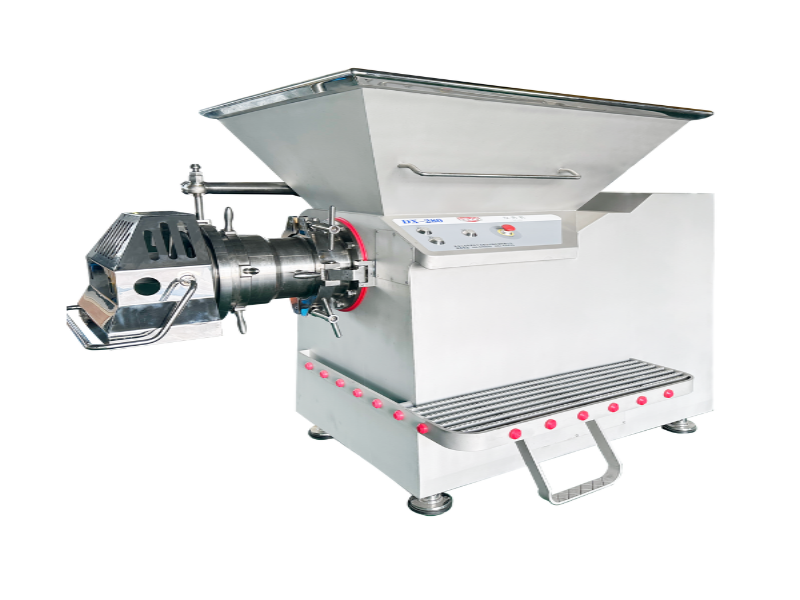
Both designs operate by moving raw materials through a grinding system where rotating components push the material toward cutting plates. This mechanism enables consistent particle size while maintaining steady throughput during long production periods.
Key characteristics of these industrial grinders include:
● Structural components manufactured from 304 stainless steel, supporting food hygiene requirements
● Precision-machined parts that contribute to stable operation with reduced vibration
● Enlarged hoppers that allow higher volumes of raw material to enter the machine
● Protective covers and organized control areas designed for safer operation
These structural features help ensure that grinding equipment can operate efficiently in industrial environments where large quantities of meat materials must be processed continuously.
Grinding bones with a meat grinder depends largely on the density, size, and internal structure of the bones being processed. In meat processing environments, bones are not all treated equally. Some can be reduced into small particles during grinding, while others are too dense and require different equipment. Evaluating bone hardness and structure helps operators determine whether a grinding system can process the material safely and efficiently.
The following table outlines common bone categories encountered in meat processing and their general suitability for grinding.
Bone Category | Typical Source | Structural Characteristics | Suitability for Grinding |
Soft bones | Chicken, turkey | Thin walls, flexible structure | Generally suitable |
Small animal bones | Rabbit, small game | Moderate density, smaller size | Often suitable with proper preparation |
Fish bones | Marine or freshwater fish | Fragile and lightweight | Easily processed |
Medium livestock bones | Rib sections, small fragments | Thicker structure but manageable size | Conditional suitability |
Dense bones | Large leg or femur bones | High density and thick outer layers | Often unsuitable for grinding |
Soft bones are the most practical materials for grinding in many meat processing applications. These bones typically have thinner walls and lower mineral density, which allows them to break down more easily during mechanical grinding.
Poultry bones are among the most frequently processed materials. Bones from animals such as chicken or turkey are relatively flexible and contain a higher proportion of cartilage compared with larger livestock bones. This structural difference allows them to pass through grinding systems with less mechanical resistance.
Fish bones represent another category that is commonly processed. Their lightweight structure and smaller size make them easier to reduce during grinding, especially when mixed with meat materials in raw ingredient preparation.
In certain production environments, bones from smaller animals may also be processed. These bones are usually thinner than those of large livestock, which allows them to be incorporated into raw material processing streams when the grinding equipment is designed for such tasks.
Larger and denser bones present a different challenge for grinding systems. Bones such as thick leg bones from livestock contain dense outer layers and compact internal structures that require significantly more mechanical force to break down.
Because of their hardness, these bones are not typically processed in standard grinding systems used for general meat preparation. Instead, they may require specialized crushing equipment designed to break down dense materials before further processing.
When evaluating bone materials for grinding, processors often consider several factors:
● Bone thickness and density
● Overall bone size
● Whether the bone is mixed with softer meat materials
● The mechanical capacity of the grinding equipment
Dense bones that exceed the design limits of grinding systems are usually removed from the raw material stream or processed using dedicated bone crushing machines designed for high-impact mechanical force.
Industrial bone processing places significantly higher demands on grinding equipment than standard meat grinding. Bones introduce higher mechanical resistance, increased friction, and greater wear on internal components. For this reason, an industrial meat grinder designed for bone-related processing must combine durable materials, precision manufacturing, and practical operational design to ensure stable performance in large-scale production environments.
Feature Category | Design Focus | Operational Benefit |
Structural materials | 304 stainless steel frames and sheet components | Supports food hygiene and corrosion resistance |
Precision manufacturing | CNC-machined components and reinforced structure | Improves stability and durability during heavy workloads |
Feeding system | Enlarged hopper and optimized material flow | Allows higher input volume and smoother feeding |
Safety protection | Protective covers and guarded working areas | Reduces operational risks during processing |
Machine layout | Organized control panel and functional component arrangement | Simplifies operation and maintenance |
A strong structural design is essential when processing bone-containing raw materials. Compared with soft meat grinding, bone grinding produces higher mechanical stress on the grinder’s frame, cutting components, and transmission system. Equipment used in industrial environments must therefore be built with materials that can maintain stability during long periods of continuous operation.
One commonly used material in professional meat processing machinery is 304 stainless steel. This material provides several advantages in industrial food production environments. It offers corrosion resistance when exposed to moisture and raw meat materials, and it helps maintain hygienic processing conditions that meet food safety requirements. Structural components made from this material also provide strong mechanical support for the grinder body.
In addition to material selection, welded structural parts often undergo heat treatment processes to increase strength and durability. These reinforced structures allow the grinder to maintain consistent performance even when processing large quantities of raw materials over extended production cycles.
In large processing facilities, grinders are often expected to operate continuously as part of an integrated production line. Stability during long operating periods becomes a key factor in equipment design. Precision manufacturing of machine components helps ensure that moving parts work smoothly together without excessive vibration.
High-precision machining techniques are commonly used to manufacture critical components of industrial grinders. Accurate component tolerances help maintain consistent rotation, stable pressure within the grinding system, and uniform particle size in the processed material. Reduced vibration and controlled mechanical movement also contribute to lower noise levels during operation.
Stable operation is particularly important in industrial meat processing environments where equipment must handle high throughput while maintaining reliable performance. Consistent mechanical performance helps prevent interruptions in the production line and supports predictable processing results.
Beyond structural strength and operational stability, the overall design of the machine must support efficient and safe daily operation. Industrial grinders often incorporate design elements that improve workflow and reduce the workload for operators.
An enlarged hopper is a common feature in industrial grinding equipment. By allowing larger quantities of raw materials to be loaded at once, the hopper helps increase processing efficiency and reduce the frequency of manual feeding. This design also supports smoother material flow into the grinding system.
Protective covers are another important design element. These covers help shield the working area of the machine and provide an additional layer of operational safety during processing. Combined with clearly arranged control panels and functional component layouts, these design features help operators manage the equipment more easily while maintaining a safer working environment.
Operating an industrial meat grinder for bone-containing materials requires careful preparation of raw inputs and consistent maintenance practices. Proper handling not only protects mechanical components but also helps maintain stable grinding performance throughout the production cycle.
Operation Stage | Key Action | Purpose |
Raw material preparation | Cut bones and meat into manageable sizes | Ensures smooth feeding and reduces mechanical strain |
Feeding process | Introduce materials steadily into the hopper | Maintains consistent grinding flow |
Post-operation cleaning | Remove residue from grinding components | Prevents buildup and supports hygienic processing |
Equipment inspection | Check plates, knives, and moving parts | Identifies wear before it affects performance |
Before materials enter the grinder, raw inputs should be prepared to match the capacity of the machine. Cutting materials into appropriate sizes helps prevent blockages in the feeding system and allows the grinder to process materials more evenly. When raw materials are too large or irregular, they can interrupt material flow and place additional stress on internal components.
Maintaining a steady feeding process is also important. Gradual feeding helps the grinder maintain consistent pressure within the grinding chamber and supports uniform particle size during processing.
Regular cleaning is essential after each production cycle. Residual meat or bone particles left inside the grinder can harden over time, which may affect both hygiene and machine performance. Disassembling removable parts for cleaning allows operators to remove residue more effectively.
Routine inspection should also be performed on key working components. Grinding plates, knives, and other moving parts should be checked for wear or damage so that maintenance can be performed before operational issues occur.
In industrial processing, the question of what meat grinder will grind bones is best answered by using specialized equipment designed for bone processing. Machines like the Single Screw Meat Grinder and Double Screw Meat Grinder from QI QI HAR SUNBY MACHINERY CO., LTD. are engineered to handle bone-containing materials efficiently. These grinders provide the necessary strength and durability, making them ideal for large-scale meat processing operations.
A: A meat grinder with a high-power motor and durable components, such as the Single Screw Meat Grinder or Double Screw Meat Grinder, is best suited for grinding bones in industrial settings.
A: No, standard meat grinders are not designed to grind bones. Industrial grinders with reinforced gears and high torque are required for efficient bone processing.
A: Meat grinders can process soft bones, like poultry or fish bones, while harder bones, such as those from larger animals, require specialized equipment.


